Budgets vary by market, level of care, and competition. The focus isn’t just on spending; it’s whether that spend is producing qualified calls and admits at a sustainable cost.
Google Ads That Drive Admissions, Not Just Leads
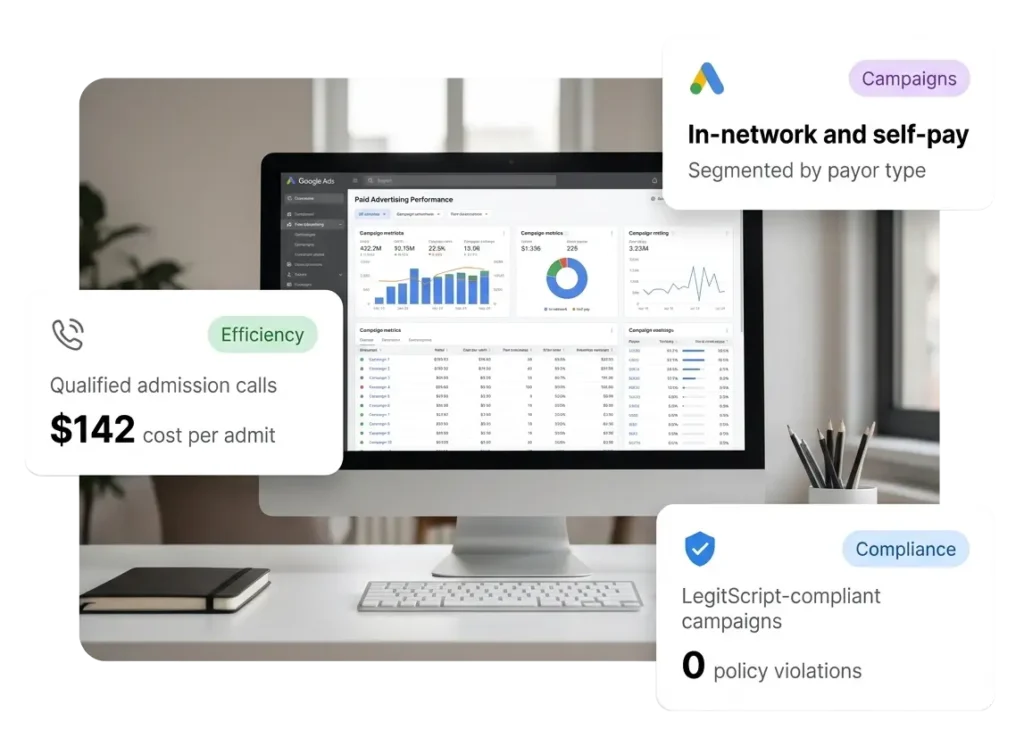
We run Google Ads for drug rehabs, detox centers, alcohol treatment centers, and behavioral health providers with one goal: driving qualified inquiries that convert into admissions, not just traffic or form fills. As the Google Ads agency for treatment centers – built on compliance, cost-per-admit, and the standards required for PPC in healthcare – Rehab Marketing measures success the same way your CFO does.
Why Most Google Ads Don’t Turn Into Admits
Most pay-per-click (PPC) campaigns in this category don’t fail because of budget. They fail because they’re built without understanding how treatment centers actually operate.
We focus on aligning paid search with admissions, payor mix, and compliance – not just traffic or lead volume. LegitScript Google Ads compliance alone separates campaigns that stay online from ones that go dark – and most PPC agencies don’t know the difference. This is exactly why PPC in healthcare demands more scrutiny than other verticals – the compliance stakes are higher, and the margin for error is smaller. And these are the gaps we see most often:
- They Ignore Compliance Requirements
Campaigns are launched without fully accounting for Google’s healthcare policies and LegitScript requirements, which can limit performance or lead to disruptions. - They Don’t Account for Payor Mix
All inquiries are treated the same, without distinguishing between insurance types, self-pay, or what actually converts into revenue. - They Optimize for Volume, Not Quality
Campaigns are measured by clicks and form fills instead of qualified calls and admissions. - They Aren’t Aligned with Intake Reality
Ads drive inquiries that don’t match what the admissions team can convert, creating friction between marketing and operations.
This is why many rehab ads look active but don’t consistently produce admits. Real Google Ads for rehab expertise is what separates the two. The next step is to evaluate how your campaigns are structured and what they’re actually generating.

How PPC Should Work for Treatment Centers
Effective Google Ads for rehab campaigns in this category aren’t built around traffic. They’re built around how patients search, how facilities operate, and what actually turns into admissions.
At Rehab Marketing, we structure campaigns around the factors that directly impact conversion, not just visibility. Drug rehab PPC has to account for payor mix, level of care, and intake reality before a single dollar is spent.
These are the elements that define high-performing PPC:
Intent-Based Targeting
Campaigns are built around high-intent searches from patients and families actively looking for treatment, not general research traffic.
Payor Segmentation
Campaign structure separates insurance types and self-pay audiences, allowing the budget to be allocated toward what actually drives revenue.
Level-of-Care Campaigns
Each level of care is treated as its own funnel, with messaging and targeting aligned to the patient’s stage and urgency.
Intake-Aware Funnels
Campaigns are designed around what your admissions team can realistically convert, reducing wasted inquiries and improving efficiency.
Call Quality Over Volume
Success is measured by qualified calls and admissions, not total lead count or surface-level engagement metrics.
This is the difference between campaigns that generate activity and campaigns that drive admissions. Understanding how your current setup compares is the first step to improving performance.
Are Your Ads Running But Not Converting?
If your campaigns are active but not producing qualified calls or admits, the issue isn't volume – it's how they're built. Take a closer look at what your campaigns are actually producing and where the gaps are.
How We Build High-Performing Campaigns
Campaign performance isn’t determined by budget alone. It’s driven by how each part of the system is built, connected, and optimized to move someone from search to call. This is how drug rehab PPC campaigns are engineered to convert, not just run.
These are the components that control how your campaigns perform and what kind of inquiries they generate:
Campaign Structure
Accounts are organized by level of care, location, and intent to ensure budgets are directed toward the highest-value opportunities.
Ad Copy
Messaging is written to match urgency, patient intent, and payor context, encouraging qualified calls rather than generic clicks.
Keyword Strategy
Targeting focuses on high-intent searches, with continuous refinement to remove low-quality traffic and improve efficiency.
Landing Pages
Pages are built to support conversion, with clear next steps, trust signals, and alignment with what the ad promises.
Call Tracking
Every call is tracked and attributed, allowing performance to be measured based on real inquiries, not assumptions.
Compliance Setup
Campaigns are built with healthcare policies and LegitScript requirements in mind to reduce risk and maintain stability.
Each of these components works together to give you control over performance, not just visibility. The next step is to review how your current setup is built and where it’s limiting results.
How Campaigns Are Actively Managed
Campaigns don’t perform because they’re launched correctly. They perform because they’re continuously adjusted based on real data and real outcomes. This is the ongoing work that improves efficiency, lead quality, and admissions over time:
Daily and Weekly Optimization
Campaigns are monitored and adjusted regularly to respond to performance trends, not left to run on autopilot.
Budget Allocation
Spend is shifted toward the campaigns, locations, and audiences that are producing the strongest results.
Bid Adjustments
Bids are refined based on device, location, time, and intent signals to improve efficiency and control cost.
Search Term Mining
Incoming search data is reviewed to identify high-performing queries and eliminate irrelevant traffic.
Exclusion Lists
Negative keywords are continuously expanded to filter out low-quality searches and protect the budget.
CRO Feedback Loop
Insights from calls and conversions are fed back into campaign adjustments to improve targeting and outcomes.
This is what separates campaigns that stay flat from ones that improve over time. Moreover, campaigns that aren’t actively managed at this level are almost always leaving performance on the table. Contact us now at Rehab Marketing to optimize your PPC.
Built for the Way You Measure
PPC performance isn’t defined by clicks or impressions. It’s defined by what actually turns into revenue and admits. At this level, the focus shifts from activity to outcomes – how efficiently the budget turns into qualified inquiries and how those inquiries convert.
- CAC by Payor
Acquisition cost is tracked by insurance type and self-pay, not blended into a single number that hides performance differences. - Cost per Admit
Performance is measured by what it takes to generate an actual admission, not just an inquiry or call. - Call Quality
Calls are evaluated based on intent and qualification, not total volume. - Inquiry to Admit Ratio
The full funnel is tracked to identify where conversion breaks between marketing and intake. - Attribution
Calls, forms, and CRM data are connected to understand which campaigns are actually driving results.
This is what turns PPC from a reporting exercise into a controllable acquisition channel. Rehab ads only earn their spend when they’re measured this way. When performance isn’t visible at this level, the issue usually isn’t budget – it’s the lack of visibility itself.


Where This Approach Fits Best
This service is built for treatment centers and behavioral health providers where paid search is directly tied to admissions and revenue. Google Ads for rehab that isn’t handled at this level of specificity will always feel inconsistent. Including:
- Drug rehabs, alcohol rehabs, medical detox centers, sober living facilities, residential, PHP, IOP, and outpatient programs that require intent-based targeting by level of care
- Operators balancing in-network and self-pay, where the lead value varies significantly
- Substance abuse programs and recovery centers scaling or stabilizing who need consistent lead quality, not just volume
- High-spend drug treatment operators focused on controlling cost per admit and improving efficiency
If PPC is a meaningful part of your acquisition mix, how it’s structured and managed will directly impact performance. Find out where yours currently stands.
FAQs Before You Invest in PPC
- How much should we expect to spend?
- How long until we see results?PPC can generate inquiries quickly, often within the first few weeks. Consistent performance improves over time as campaigns are refined and data is used to adjust targeting and spend.
- How does compliance factor into PPC?Campaigns in this category must align with Google’s healthcare policies and LegitScript requirements. If compliance is handled incorrectly, it can limit performance or lead to account issues. This is one of the sharpest differences between PPC in healthcare and PPC in almost any other industry.
- Why wouldn’t our current agency be doing this already?Most agencies run PPC as a generic service. They focus on traffic and lead volume, not payor mix, intake realities, or cost per admit, which are critical in this space.A drug rehab PPC agency that understands UR, VOB, and ASAM levels builds campaigns differently from the ground up.
- What should we realistically expect from PPC?PPC should produce a steady flow of qualified inquiries that your admissions team can convert. It’s not about volume alone; it’s about consistency and efficiency over time.
Your Google Ads should be producing a steady flow of qualified calls and admissions, not inconsistent results and unclear performance. Google Ads for rehab centers should function like a controlled acquisition system — predictable inputs, measurable outputs, and zero wasted spend.If your pipeline feels unpredictable or your cost per admit keeps fluctuating, the issue is in how the campaigns are structured and managed.
Take a look at what your campaigns are actually producing and what it’s costing you.
Every Dollar Should Be Traceable to an Admission
If your cost per admit is a mystery, that’s the first thing worth fixing. Today, request a campaign performance review to see exactly where your spend is going.
Get in touch
Location