SEO compounds. The first 60 days focus on fixing issues and building the foundation. Ranking improvements typically appear in months 3 to 4, with traffic and inquiry growth in months 4 to 9, depending on competition and site condition. We structure campaigns so that faster channels support results while SEO builds.
Drug Rehab SEO & Search Visibility for Treatment Centers
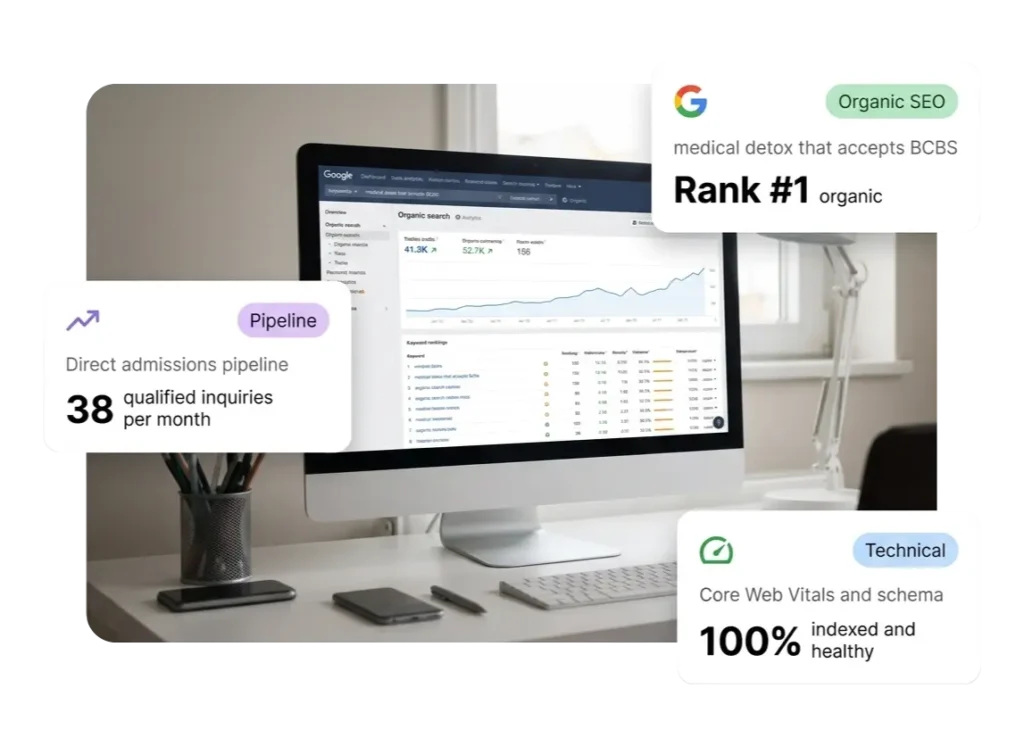
We build SEO for drug rehabs, alcohol treatment centers, detox facilities, sober living programs, and behavioral health providers – focused on one outcome: patients who find you, call you, and clear insurance. As a specialized drug rehab SEO agency, Rehab Marketing measures what shows up in your CRM, not your rankings.
Drug Rehab SEO & Search Visibility for Treatment Centers
We build SEO for drug rehabs, alcohol treatment centers, detox facilities, sober living programs, and behavioral health providers – focused on one outcome: patients who find you, call you, and clear insurance. As a specialized drug rehab SEO agency, Rehab Marketing measures what shows up in your CRM, not your rankings.
Why Your SEO Isn’t Driving Admissions
Most agencies are optimizing for the wrong things.
They chase keyword rankings instead of patient intent. They publish blog posts about “10 signs of addiction” that bring in traffic from people researching for school papers. They build backlinks from directories nobody reads. They also report on impressions and click-through rates and call it growth. Six months in, your traffic is up, your admissions are flat, and your CFO is asking why.
Generic drug rehab SEO chases visibility. What you need is a rehab SEO program tied to admissions. Here at Rehab Marketing, we take a completely different approach. Our experts build drug rehab SEO programs for treatment centers and behavioral health providers focused on one outcome: driving the right searches that turn into real inquiries and qualified admits. That means we measure performance based on what shows up in your CRM, not just what shows up in a ranking report.
If your current SEO looks good on paper but isn’t translating into admissions, it’s time to take a closer look at what it’s actually producing.

What Effective Treatment Center SEO Actually Looks Like
SEO that drives admissions is built differently. It focuses on intent, structure, and how patients actually search, not just on increasing traffic. Drug rehab SEO works differently because the patient journey is different – urgency, insurance, geography, and level of care all shape how people search. These are the core components most treatment center SEO programs miss:
Intent-First Keyword Strategy
The keywords that bring traffic are not the same as the ones that drive admissions. Informational searches generate volume but rarely convert, while high-intent queries tied to insurance, location, and level of care lead to real inquiries – searches like “drug rehab near me,” “alcohol detox center Dallas,” “sober living Houston,” and “medical detox accepts BCBS.” We prioritize the second.
Level-of-Care and Specialty Targeting
Patients searching for detox, residential, PHP, IOP, or outpatient care are in different stages of urgency and decision-making. We build dedicated pages for each level of care and, for behavioral health, each clinical specialty.
Geographic Architecture That Ranks
A single “we serve this area” page doesn’t compete in search. We build structured city and neighborhood pages for every market you target, supported by local intent signals, schema, and internal linking.
Cannibalization Cleanup
Years of blog content often create overlap, with multiple pages competing for the same keywords. We audit, consolidate, and restructure content to remove conflicts and recover lost rankings.
Schema, Technical SEO, and Site Health
Behind-the-scenes structure determines whether your site performs at all. We implement schema, fix technical issues, and maintain site health so your content is properly indexed and trusted by search engines.
When these elements are in place, SEO stops being a content exercise and starts becoming a reliable source of qualified inquiries. If your current strategy isn’t built this way, it’s worth understanding where it’s falling short. Contact us at Rehab Marketing to get started.
Is Your SEO Working, or Just Ranking?
Your rankings might be improving, but that doesn't mean your SEO is working. If you're not seeing that traffic turn into qualified inquiries and admits, something in the strategy is off. Let's take a closer look at what's actually happening.
Who This Is Designed For
Most SEO programs start with execution. Ours starts with diagnosis, because without understanding what’s actually broken, nothing you build on top of it will hold. We begin with a structured 90-day diagnostic, then transition into a system designed to compound results over time. These are the phases we follow at Rehab Marketing:
Phase 1:
Audit & Diagnosis (Weeks 1-3)
Full technical audit, site-wide cannibalization analysis, keyword and ranking baseline, and competitive review of the facilities winning your market. We also assess your backlink profile and integrate CRM and call tracking so attribution is measurable from day one.
Phase 2:
Strategic Plan (Weeks 4-6)
A clear, written roadmap outlining what gets fixed, rewritten, created, or removed, along with the order of execution. Every action is tied to impact on inquiries and admissions, not generic deliverables or content quotas
Phase 3:
Execution & Compounding (Month 3+)
Implementation across content, technical SEO, on-page optimization, link building, local SEO, and schema. The focus is on building a system that compounds over time, not one that resets with each monthly cycle.
Phase 4:
Measurement & Iteration (Ongoing)
Ongoing reporting tied to inquiries, qualified admits, and cost per acquisition by channel. Quarterly strategy reviews ensure the work stays aligned with your operations, performance goals, and market conditions.
A process like this brings structure to what is often treated as guesswork and turns SEO into a channel you can actually manage. Take a closer look at how your current approach is structured and where it may be falling short.
The Full Scope of Our SEO Programs
SEO that drives admissions is not one tactic – it’s a coordinated set of work across technical, content, and strategic layers. Each part plays a role in turning search visibility into real inquiries.
A treatment center SEO company that delivers real admissions builds across all of these layers – not just content, not just backlinks. These are the components we build and manage as part of a complete SEO program at Rehab Marketing:
- Technical SEO Audits & Implementation
Site speed, Core Web Vitals, crawlability, indexation, schema markup, and the technical foundation your site needs to perform consistently. - Keyword Strategy & Mapping
Intent-first keyword research mapped to your levels of care, specialties, payors, and target geographies. - On-Page Optimization
Title tags, meta descriptions, heading structure, internal linking, and content refinement across the pages that drive inquiries. - Content Strategy & Production
Pillar pages, level-of-care pages, city and neighborhood pages, condition pages, and long-tail content aligned with real patient and family search behavior. - Cannibalization Audits & Cleanup
Auditing existing content, consolidating overlap, redirecting underperforming pages, and recovering lost rankings caused by internal competition. - Local SEO & Map Pack Optimization
Google Business Profile optimization, citation building, review strategy, and local schema to strengthen visibility in “near me” searches. - Link Building & Digital PR
Earning healthcare-relevant backlinks from credible sources that improve authority without relying on low-quality tactics. - AI & LLM Visibility (GEO)
Optimization for ChatGPT, Perplexity, and Google’s AI Overviews, where more patients are beginning their search. - Reporting & Attribution
Monthly reporting tied to inquiries and admits, with CRM integration so marketing and admissions data are connected.
All of these components work together to turn SEO into a channel that consistently produces qualified inquiries, not just traffic.


Metrics That Actually Drive Decisions
SEO only matters if it can be measured in a way your business understands. Here at Rehab Marketing, we focus on the numbers that actually drive decisions, not the ones that just fill reports. After all, most SEO reports are built around metrics that don’t impact revenue. Impressions. Click-through rates. Average position. Domain authority. Useful for diagnostics, but not for the conversations you’re having with your CFO.
These are the metrics we report on and optimize for:
- Qualified Inquiries by Source
Which pages, keywords, and campaigns are actually generating calls and form submissions from potential patients. - CAC by Channel
The real cost of acquiring an inquiry across organic search, paid media, referrals, and owned channels. - Inquiry-to-Admit Ratio
Where the conversion process breaks between marketing and intake, and where improvements can be made. - Pipeline Influence
Which content and keywords are part of the patient journey leading up to the inquiry, even when they’re not the final touchpoint.
This level of visibility changes how decisions get made and what gets prioritized. Take a closer look at what your current reporting is actually telling you.
SEO Built for Treatment Center Operators
This SEO approach is built for treatment centers and behavioral health providers that want to generate consistent admissions without relying entirely on paid channels. It’s designed for operators who need search to function as a predictable, long-term acquisition channel, not just a traffic source. This service is built for:
Addiction Treatment Centers
Drug rehabs, alcohol rehabs, medical detox centers, sober living facilities, residential treatment programs, PHP, IOP, outpatient, and dual-diagnosis programs with ongoing demand for qualified admissions.
Behavioral Health & Mental Health Providers
Psychiatric facilities, eating disorder programs, trauma programs, and specialty practices with longer decision journeys and referral-driven pipelines.
Multi-Location Operators
Regional and national platforms managing SEO across multiple facilities, requiring consistent structure, scalability, and performance across markets.
Facilities Over-Reliant on Google Ads
Operators looking to reduce paid dependency and build a more balanced acquisition strategy that supports long-term growth.
From behavioral health SEO to multi-location rehab platforms, the underlying system is the same: intent-first, technically sound, and measured in admits. This model scales whether you’re operating a single facility or managing a multi-state platform, with the same fundamentals applied at every level.
What Treatment Centers Ask Before Partnering with Us
- How long until we see results from SEO?
- We’ve been doing SEO for years. What would you do differently?We start by auditing what already exists. Most sites have overlapping or underperforming content. We rebuild keyword strategy around intent and level of care, then fix technical and schema issues that are often overlooked.
- Do you guarantee rankings?No. Any agency that does is either misleading or violating guidelines. What we guarantee is a clear methodology, transparency, and accountability to admissions-focused metrics.
- Can you work with our existing site, or do we need a rebuild?In most cases, we improve the existing site. If the technical foundation is too limited, we’ll recommend a rebuild. You’ll get a clear recommendation during the audit.
- What about Google Ads suspensions and LegitScript compliance?SEO and paid media compliance are related. Our drug rehab SEO work aligns with LegitScript and Google policies, and we handle reinstatements when accounts or profiles are suspended.
- Do you work with facilities outside the U.S.?Our core focus is U.S.-based treatment centers and behavioral health providers. We’ve worked internationally, but U.S. markets are where we have the deepest experience.
Make Your SEO Work Where It Matters
The patients you want to admit are searching right now.
The question is whether your SEO is built to find them or to fill a ranking report.
Let's see if we are the right partner.
We work with a limited number of facilities because true patient acquisition requires focus.
Get in touch
Location