Ranking in one or two markets doesn’t guarantee visibility across all of them. Multi-location SEO is about building consistency so each location performs, not just a few.
Local SEO & Map Pack Dominance for Drug Rehabs and Treatment Centers
Rehab Marketing builds local SEO systems for drug rehabs, detox centers, alcohol treatment facilities, and behavioral health providers operating across multiple markets. Map pack visibility, location-level performance, and consistent inquiries in every area you serve.
Local SEO & Map Pack Dominance for Drug Rehabs and Treatment Centers
Rehab Marketing builds local SEO systems for drug rehabs, detox centers, alcohol treatment facilities, and behavioral health providers operating across multiple markets. Map pack visibility, location-level performance, and consistent inquiries in every area you serve.
Why Local SEO Breaks at Scale
Local SEO changes once you move beyond a single location. What works for one facility doesn’t naturally extend across multiple markets, especially without a system designed for scale. As more locations are added, visibility becomes inconsistent, not because demand isn’t there, but because the structure isn’t built to support it.
We often see location pages duplicated with minimal variation, weakening their ability to rank in specific markets. Location signals become unclear, making it harder for search engines to confidently associate each facility with its service area. Google Business Profiles start to drift, with inconsistencies across listings that affect trust and map pack performance.
Over time, what started as a working setup turns into a fragmented system where each location performs differently for reasons that aren’t always obvious.
At this stage, local SEO is no longer about optimizing individual pages. It’s about building a system that can support multiple locations consistently. Without that structure, growth tends to create more gaps instead of more visibility.
This is where local SEO shifts from a simple setup to a system that needs to be designed for scale. This is especially common for drug rehab centers and detox facilities expanding into new metro areas. For drug rehab local SEO specifically, that shift usually happens the moment a second location opens – and most setups weren’t built for it. When visibility drops as you expand, it’s usually a structure issue, not a demand issue.

What Map Dominance Actually Looks Like
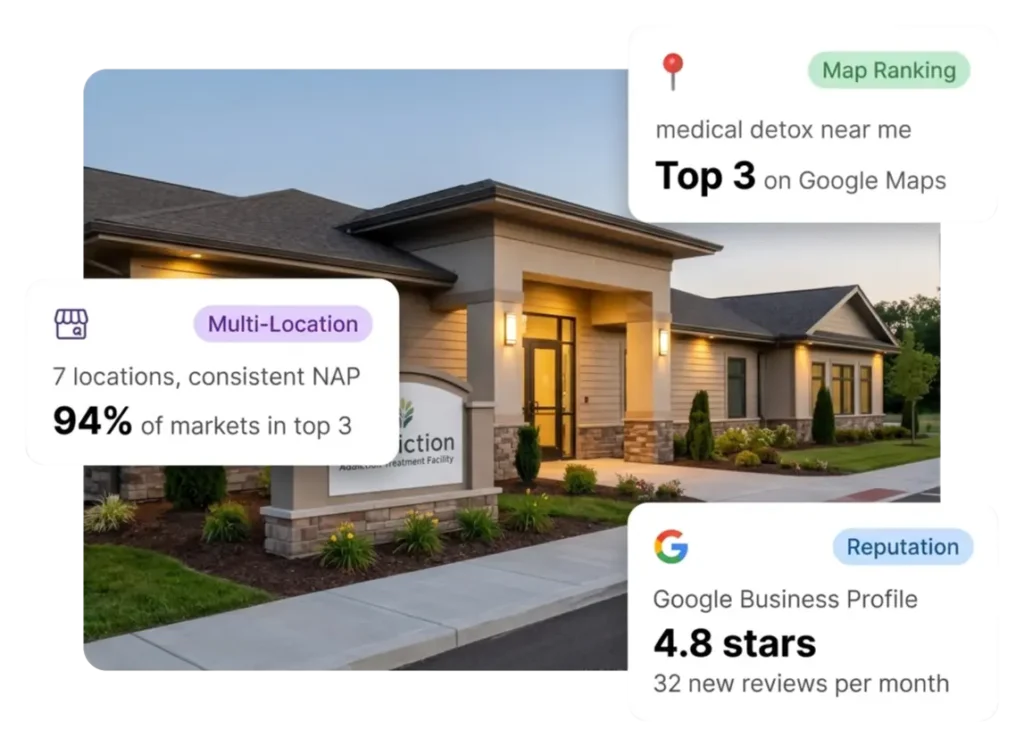
Local SEO at scale isn’t about ranking occasionally. It’s about showing up consistently across every market you operate in for the searches that actually drive calls. For drug rehabs and treatment centers, map dominance means consistent visibility, accurate location signals, and performance that holds across every location, not just one or two. This is what that looks like:
Top 3 Map Pack Presence
Your locations consistently appear in the top results for high-intent local searches, where most calls and inquiries happen.
Consistent NAP Across Locations
Name, address, and phone number data are aligned across all listings and directories, reinforcing trust and accuracy.
City-Level Visibility
Each location ranks within its own service area, not just the primary city or headquarters.
Review Volume and Velocity
Locations generate a steady flow of recent reviews that support both rankings and decision-making.
Local Relevance Signals
Content, listings, and on-site signals clearly indicate where you operate and what services you offer in each market.
This is the difference between having a presence and actually controlling visibility in your markets. If your locations aren’t consistently showing up in the map pack, it’s usually a signal problem, not a demand problem.
Are Your Locations Competing Against Each Other?
If some locations perform while others don't, it's usually not the market. It's the system behind how visibility is built. Work with us at Rehab Marketing to understand which markets are driving visibility and which ones are falling behind.
How We Build Multi-Location Visibility
Local visibility at scale isn’t created page by page. It’s built through a structured system that connects locations, content, and signals across every market you operate in.
Rehab Marketing focuses on building that structure so each location performs as part of a coordinated system, not as isolated pages competing for visibility. Local SEO at scale only works when the architecture is built to reinforce each location rather than fragment it. This applies whether you’re operating drug rehabs, alcohol rehabs, detox centers, sober living facilities, or recovery centers across one region or many.
These are the core components that make that possible:
- Location Page Structure:
Each location is built with a clear structure that reflects services, geography, and intent, allowing it to rank within its own market. - City Page Expansion:
Supporting pages are created to capture visibility across surrounding areas, not just the primary city tied to each facility. - Internal Linking:
Pages are connected in a way that reinforces geographic relevance and distributes authority across locations. - Schema Per Location:
Structured data is implemented at the location level so search engines can clearly understand services, coverage, and relevance. - Geo Signals:
Location-based signals are built across the site and external sources to strengthen association with each market.
This is what allows multi-location SEO to scale without losing clarity or performance. If your current setup isn’t structured this way, locations tend to compete with each other instead of building collective visibility.


Google Business Profile, Done at Scale
For multi-location providers, the map pack isn’t controlled by your website alone. It’s driven by how each Google Business Profile is built, optimized, and maintained across every market you serve.
Here at Rehab Marketing, we treat each location as its own performance unit. Google Business Profile management for rehabs at scale requires a different discipline than single-location setup — categories, services, review velocity, and post cadence all need to be calibrated per market. That means refining categories and services so they accurately reflect what each facility offers, aligning listings with the searches that drive calls, and maintaining consistency across every profile. Posting isn’t treated as filler – it’s used to reinforce activity and relevance over time.
Reviews are managed with intention, not just volume. We focus on generating a steady flow of recent, relevant feedback that supports both rankings and conversion, while also ensuring responses strengthen trust and credibility.
At the same time, map pack performance isn’t just about your listings. It’s also about understanding how competitors are positioned in each market and identifying where they’re gaining visibility. That allows us to adjust signals and strengthen your presence so your locations are competing from a position of control, not reacting after the fact.
For drug rehab centers and detox facilities, an optimized Google Business Profile often drives more inquiries than the website itself. If your locations aren’t consistently appearing in the map pack, this is usually where the gap is.
Reviews, Reputation, and Local Signals
In this category, reviews don’t just influence rankings. They directly impact whether someone decides to call. That makes reputation both a visibility factor and a conversion factor at the same time. This is how that layer is built and managed:
Review Generation Systems
Systems are built to generate a steady flow of reviews over time, aligned with discharge timing and patient readiness, rather than relying on one-off requests.
Handling Negative Reviews
Negative feedback is addressed with context and consistency, protecting credibility while showing how issues are handled in a real-world setting.
Discharge and Timing Considerations
Review strategy accounts for the realities of treatment, where timing, sensitivity, and ethics all influence when and how feedback can be collected.
Trust Signals
Listings are supported by consistent information, credibility indicators, and signals that reinforce legitimacy across every location.
Reviews are managed with intention, not just volume. We focus on generating a steady flow of recent, relevant feedback that supports both rankings and conversion, while also ensuring responses strengthen trust and credibility. This is what turns reviews from something passive into something that actively supports both rankings and decision-making.
Metrics That Matter at the Location Level
Local SEO at scale isn’t measured at the account level. It’s measured market by market, based on how each location performs and contributes to overall admissions.
At this level, visibility only matters if it turns into calls and inquiries in the markets you actually operate in.
- Calls Per Location:
Performance is tracked based on how many calls each location is generating, not just total volume across the account. - Map Pack Visibility:
Visibility is measured by how consistently each location appears in the map pack for high-intent local searches. - Cost Per Inquiry by Market:
Acquisition efficiency is evaluated at the market level, showing what it takes to generate an inquiry in each location. - Location-Level Performance:
Each location is assessed individually to identify which markets are driving results and which ones need improvement.
This is what turns local SEO into something measurable and controllable across multiple markets. If performance is uneven across locations, the data usually points to where structure or signals need to be strengthened.


When Local SEO Needs Structure
This service is built for operators managing multiple locations where local visibility needs to be consistent across markets, not just strong in one.
- Multi-location drug rehabs, detox centers, and behavioral health providers operating across several cities or regions
- Expanding substance abuse programs and recovery centers opening new locations and needing visibility to scale with growth
- Facilities in competitive metros where map pack positioning directly impacts call volume
- Franchise-style or multi-brand setups that require structured, location-level SEO
If local performance varies significantly from one location to another, it’s usually a sign that the structure isn’t keeping up with growth. A local SEO agency for treatment centers that understands this distinction builds systems, not just pages.
Local SEO Questions, Answered
- Do we need this if we already rank in some locations?
- How long does it take to see results in each market?Timelines vary based on competition, current structure, and how established each location is. Some markets improve faster, while others take longer to stabilize and grow.
- Can existing locations be fixed, or do we need to start over?Most setups can be improved without rebuilding everything. The focus is usually on restructuring pages, fixing signals, and aligning listings rather than starting from scratch.
- What happens if we have duplicate listings or pages?Duplicates can weaken visibility and create confusion for search engines. Cleaning them up and consolidating signals is a key part of improving performance across locations.
Own Your Markets Before Your Competitors Do
Local search isn’t evenly distributed. In every market, a small number of providers capture the majority of visibility, calls, and inquiries. If your locations aren’t consistently showing up in the map pack, those opportunities are going to competitors who have built stronger local signals.
The goal isn’t just to be present. It’s to control visibility across every market you serve.
Let's see if we are the right partner.
We work with a limited number of facilities because true patient acquisition requires focus.
Get in touch
Location